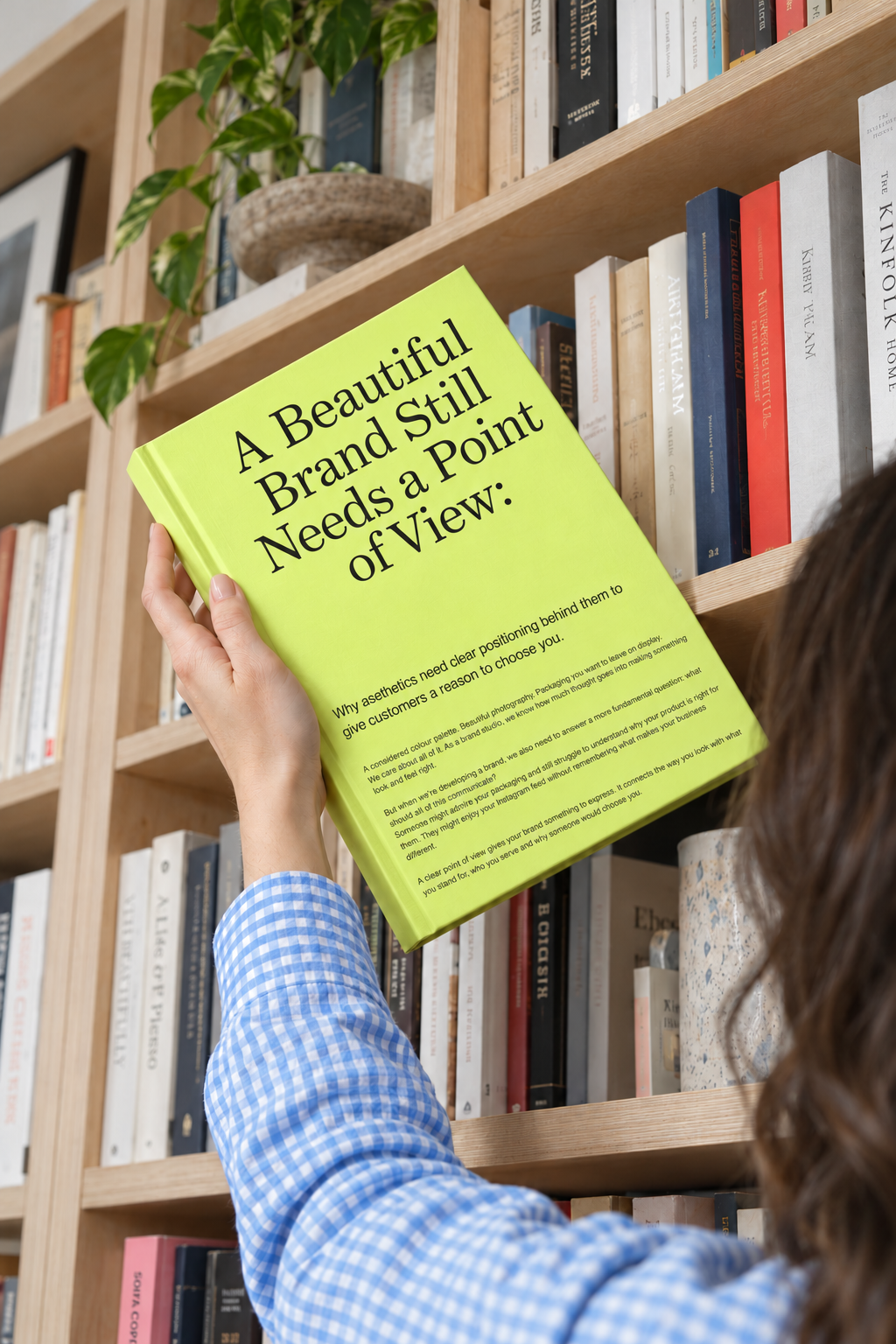
Good design gets attention. Clear positioning gives that attention somewhere to go.
A considered colour palette. Beautiful photography. Packaging you want to leave on display.
We care about all of it. As a brand studio, we know how much thought goes into making something look and feel right.
But when we’re developing a brand, we also need to answer a more fundamental question: what should all of this communicate?
Someone might admire your packaging and still struggle to understand why your product is right for them. They might enjoy your Instagram feed without remembering what makes your business different.
A clear point of view gives your brand something to express. It connects the way you look with what you stand for, who you serve and why someone would choose you.
“Beautiful” is a description, not a position
Words like premium, elevated, timeless and considered appear in plenty of brand briefs. They can describe an ambition, but they leave a lot open to interpretation.
What does premium mean for your business? Exceptional materials? Specialist expertise? A more personal service? A product that performs a particular job especially well?
And why should that matter to your customer?
We ask these questions because a visual direction becomes stronger when there is something specific behind it. “Elevated skincare” gives us an aesthetic starting point. A straightforward routine for people overwhelmed by complicated skincare gives us a clearer idea to build around.
That idea can influence the product range, the language, the packaging hierarchy and the way someone shops.
Give people a reason to choose you
Your customers have their own priorities. They may be looking for convenience, reassurance, self-expression, performance or a more enjoyable everyday ritual.
Positioning connects what your business does well with something those people value.
It asks you to get specific about your audience, the alternatives available to them and the difference your offer makes. It also asks for evidence. If you want to be known for expertise, where does that expertise show up? If simplicity is central to your offer, how does the experience become easier?
Your point of view needs to hold up in the product and service. That gives the design something credible to communicate.
A point of view helps you make decisions
A clear position is useful long before a customer encounters your brand.
It helps you decide which products belong in the range, what your homepage should lead with and whether a campaign idea makes sense. It gives your team a shared basis for assessing creative work.
Without that foundation, feedback can become a collection of preferences. Someone likes softer colours. Someone else wants a bolder font. A competitor launches something new, and suddenly the direction shifts.
With positioning in place, we can ask more useful questions. Does this communicate the right qualities? Will it make sense to the intended audience? Does it help us become recognisable for something we want to own?
Personal taste still has a place. It becomes one consideration within a clearer brief.
Design should express the thinking
Once the strategic direction is clear, every creative choice has an opportunity to support it.
Take a homewares brand built around expressive, everyday entertaining. Its photography might show tables in use, with generous food, mixed settings and people reaching across the frame. Its language could feel welcoming and confident. Its website might help customers combine pieces without needing to buy a perfectly matched set.
Those choices express an idea about how the products belong in someone’s life.
A different homewares brand might focus on preserving traditional craftsmanship. The same category could call for closer attention to process, provenance, material and the makers behind each object.
Both can be beautiful. Their beauty serves a different purpose because each begins with a different point of view.
Distinction needs substance
An unexpected colour combination or unusual typeface can make a brand visually distinctive. The broader experience needs to give that distinction meaning.
If your packaging is expressive but your copy could belong to any competitor, part of the opportunity is lost. If your website promises a highly personal experience but makes it difficult to get help, the impression starts to weaken.
We look at these elements together because customers encounter the whole business. They move between your content, product pages, emails and packaging, forming an understanding as they go.
A shared point of view helps those encounters build on one another. The language reinforces the imagery. The imagery gives context to the product. The experience supports the promise.
Leave room for the right people
Choosing a position means making choices about what matters most.
You can be warm without sounding casual. You can be expressive without following every trend. You can offer a premium product while speaking plainly about its value.
The challenge is resisting the urge to communicate every possible quality at once. When every message carries equal weight, it becomes harder to understand what defines the brand.
We help founders establish that hierarchy: what people should understand first, what supports it and what can be discovered over time. This gives the brand clarity while leaving room for depth.
Start with what you want to be known for
Before your next packaging project, website redesign or campaign, consider what you want someone to remember after encountering your brand.
Can your team explain why a customer would choose you? Does your product support that explanation? Are your visual identity and language making it easier to understand?
The answers create a stronger starting point for design.
At Good Manners, we begin with strategy because we want the creative work to carry conviction. We bring positioning, identity and experience together so your brand has a clear idea behind the way it shows up—and the substance to keep that idea credible.
A beautiful brand deserves something meaningful to say. Let’s find your point of view.